Breathing Trainer vs Incentive Spirometer — What’s the difference?
Many people confuse breathing trainers and incentive spirometers because they look similar at first glance. Both involve breathing into a device, both are used to improve respiratory function, and both are recommended in different contexts. But choosing the wrong one for your situation means poor results at best and delayed recovery or missed fitness goals at worst. Here is a clear breakdown of what each tool does, who it is for, and how to choose the right one.
Table of Contents
What’s the main difference?
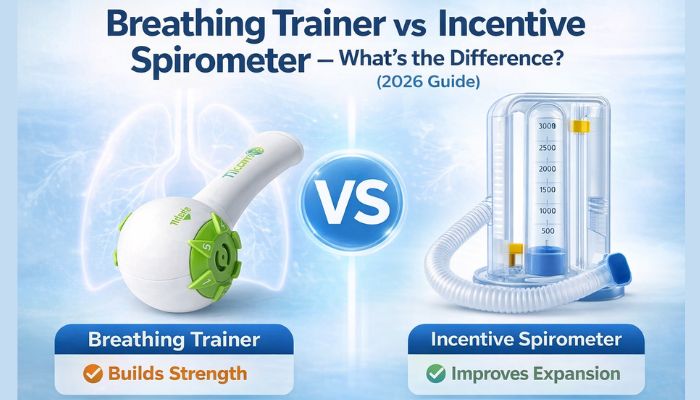
A breathing trainer builds strength by creating resistance during inhalation and exhalation, training the muscles involved in breathing. An incentive spirometer works on volume, it encourages the lungs to expand fully, primarily used in recovery and medical settings. Same action, completely different purpose.
What is a breathing trainer?
A breathing trainer is a resistance-based device that strengthens the muscles responsible for breathing, the diaphragm, intercostals, and supporting respiratory muscles. The more you use it consistently, the stronger and more efficient your breathing becomes over time. It is designed for active use fitness, performance, and long-term respiratory improvement. For a full breakdown of how it works and its benefits, refer to the breathing trainer guide.
What is an incentive spirometer?
An incentive spirometer is a volume-based device that measures and encourages deep lung expansion. It is primarily used in clinical and recovery settings after surgery, during illness, or when a patient needs to prevent lung complications from prolonged bed rest. The device gives visual feedback as you inhale, showing how much air volume, you are moving. It is a recovery tool, not a fitness one.
Key differences
| Feature | Breathing Trainer | Spirometer |
| Purpose | Strength | Expansion |
| Mechanism | Resistance | Air volume |
| Usage | Fitness / training | Recovery / medical |
| Difficulty | Adjustable | Guided |
| Results | Long-term improvement | Short-term recovery |
Which one should you choose?
Choose a breathing trainer if:
- If you want to improve stamina and endurance during physical activity
- Fitness-focused and training for performance
- Want long-term strengthening of your respiratory muscles
- For singer, athlete, or active individual looking for better breath control
For home breathing exercises, a breathing trainer for daily practice can help add structured resistance to inhale and exhale training. It is best suited for general breathing practice, fitness support, and routine respiratory muscle training, not as a replacement for a medically prescribed incentive spirometer.
Choose an incentive spirometer if:
- If you are recovering from surgery or a respiratory illness
- If your doctor has specifically recommended it as part of your recovery
- When it is need to restore lung expansion after a period of limited activity
- You have been advised to monitor and increase your breathing volume
Can you use both together?
Yes, but for entirely different goals, not as interchangeable tools. An athlete recovering from surgery might use a spirometer during the recovery phase and transition to a breathing trainer once cleared for fitness activity. They work on different aspects of respiratory function and do not replace each other. Using one when you need the other will not deliver the results you are looking for.
What are the common mistakes people make?
These are the most frequent errors that lead to frustration with both tools:
- Using a spirometer for fitness training — it is not designed for resistance work and will not strengthen your breathing muscles
- Using a breathing trainer during medical recovery without doctor guidance — resistance training on a recovering respiratory system can cause setbacks
- Expecting instant results from either tool — both require consistent use over weeks before meaningful improvement shows
- Incorrect technique — rushing through sessions, not breathing in a slow controlled manner, or using the wrong resistance setting on a trainer all reduce effectiveness significantly
Frequently Asked Questions
Are they the same thing?
No, they look similar but serve opposite purposes. One builds strength through resistance, the other supports recovery through volume measurement.
Which is better for lung capacity?
A breathing trainer improves how efficiently you use your existing lung capacity. A spirometer helps restore full lung expansion during recovery. Neither physically increases lung size.
Can a spirometer replace a breathing trainer?
No, a spirometer does not provide resistance training and cannot build the respiratory muscle strength that a breathing trainer develops.
Do athletes use spirometers?
Rarely for training purposes. Athletes primarily use breathing trainers for performance. A spirometer may be used temporarily if an athlete is recovering from a respiratory illness or surgery.

Do Breathing Trainers Actually Work? Benefits, Results (2026)