Breast milk storage guidelines: Every mom should know?
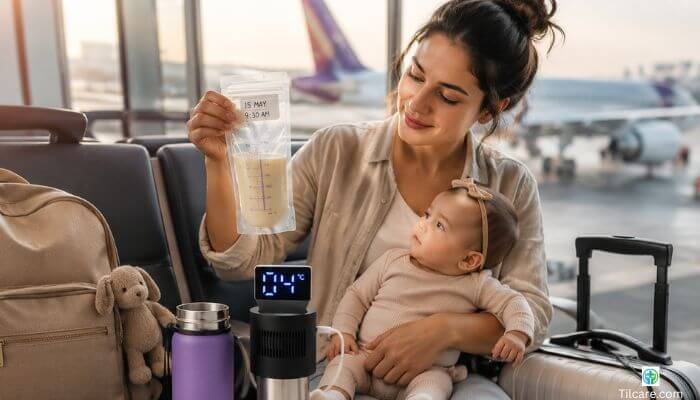
Breast milk stays safest when stored at the right temperature in clean, sealed containers and used within the recommended time for each storage method. The simpler the setup and the more consistent the habit, the less that can go wrong.
| Storage Location | Safe Duration |
| Room temperature (up to 77°F) | Up to 4 hours |
| Refrigerator (39°F or below) | Up to 4 days |
| Cooler with frozen ice packs | Up to 24 hours |
| Freezer (0°F or below) | Up to 6 months; up to 12 in a deep freezer |
These figures reflect CDC breast milk storage guidelines and represent the outer safe limits — when conditions are uncertain, the shorter end of each range is the better call.
Table of Contents
Breast milk storage guidelines, follow the “first in, first out” rule
Breast milk stored in a fridge or freezer builds up quickly across multiple pumping sessions. Without a system, newer milk gets used first while older milk sits toward the back and eventually passes its safe window wasted without anyone realising it. The fix is straightforward. Label every bottle or bag immediately after pumping with the date and time expressed. When reaching for milk to use, always take from the oldest date first. This rotation habit takes seconds and eliminates the guesswork entirely.
At a childcare setting, clear labelling also helps staff follow the same rotation without needing to ask a bottle marked with date, time, and the child’s name leaves no room for confusion.
Choose the right storage container
The container matters as much as the location. Not everything that holds liquid is appropriate for breast milk storage.
| Container Type | Pros | Cons | Best For |
| Breast milk storage bags | Pre-sterilised, lay flat, take up minimal space, easy to label | Single use, puncture risk if overpacked | Freezer storage, travel, high-volume pumping |
| BPA-free plastic bottles | Reusable, durable, compatible with most pumps | Take up more freezer space, heavier | Refrigerator storage, daily use |
| Glass containers | No chemical concerns, easy to clean, odour-resistant | Heavy, breakable, not ideal for travel | Home refrigerator or freezer use |
Whichever container type is used, it should be clean, food-safe, and sealed properly before going into storage. Avoid standard household plastic bags, disposable bottle liners, or any container not specifically designed for food storage — these are not built to maintain the integrity of stored milk.
Where should you store breast milk?
- At Home – The back of the refrigerator not the door is the coldest and most temperature-stable spot. Door shelves experience temperature fluctuation every time the fridge is opened, which adds up across a day. For freezer storage, the same principle applies: the back of a dedicated freezer holds a more consistent temperature than a combined fridge-freezer compartment.
- At Work – A dedicated space in the workplace refrigerator, clearly labelled with name and date, keeps milk organised and reduces the handling required by others. If a shared fridge is unavailable or feels unreliable, a personal insulated cooler bag with frozen ice packs kept at the desk covers a standard working day without needing fridge access at all.
- While Travelling – Travel introduces more variables than any other storage situation changing temperatures, unpredictable journey lengths, and no guarantee of fridge access at the destination. A purpose-built insulated cooler with fully frozen ice packs is the baseline requirement. For moms managing longer commutes or full days away from a fridge, an active cooling option like the Tilcare Electric Breast Milk Cooler removes the ice pack dependency entirely keeping milk consistently cold as long as power is available. For a detailed breakdown of what works best across different travel situations, refer to the guide on how to store breast milk safely while travelling.
Can you combine breast milk from different pumping sessions?
Yes, with one important condition. Freshly expressed milk should not be added directly to already-chilled milk while it is still warm. Body-temperature milk added to cold milk raises the overall temperature of the chilled portion, which counts against the safe storage time for everything in that container.
The correct approach is to cool the freshly expressed milk in the refrigerator first typically for around 30 minutes until it reaches a similar temperature to the already-stored milk, then combine. Once combined, label the new container with the date and time of the earliest expressed portion, not the most recent one. The oldest date in the blend determines when it needs to be used by.
Signs breast milk may no longer be safe
Knowing when to use milk and when to discard it is part of managing storage well. These are the situations that call for discarding rather than using:
- Storage time exceeded: If the milk has been in the fridge longer than four days, or at room temperature for longer than four hours, the safe window has passed regardless of how it looks or smells.
- Temperature uncertainty: Milk that spent time in a cooler where the ice packs fully melted, or in a fridge that experienced a power outage, cannot be confirmed as safe. When in doubt, discard.
- Damaged storage bags: A bag that has leaked, is visibly punctured, or was not sealed properly may have been exposed to contamination. Replace the container rather than transferring and using.
- Unusual smell or appearance: Breast milk can smell slightly soapy or fatty, particularly after freezing this is normal and related to lipase activity rather than spoilage. A genuinely sour or rancid smell, however, is a clear signal to discard. Separation of fat and liquid layers is normal and resolves with gentle swirling.
Avoid the instinct to over-discard out of anxiety unnecessary waste is its own problem. Use the storage guidelines consistently and trust them rather than second-guessing every session.
Frequently asked questions
What is the safest way to store breast milk?
In a clean sealed container at the back of the refrigerator, used within four days and labelled with the date and time expressed.
Can I refrigerate breast milk before freezing it?
Yes, refrigerating first and then transferring to the freezer within four days is an accepted approach for building a frozen supply.
Should breast milk be stored in bottles or storage bags?
Both are safe bags are better for freezer and travel use due to space efficiency, while bottles are more practical for daily refrigerator use.
What happens if I forget to label breast milk?
Use it as soon as possible rather than storing it further without a date, there is no way to confirm how long it has been stored or when it needs to be used by.

How to Pack Breast Milk for Travel? Quick Checklist for Moms