Best Portable Breast Milk Cooler | Buyer’s Guide 2026
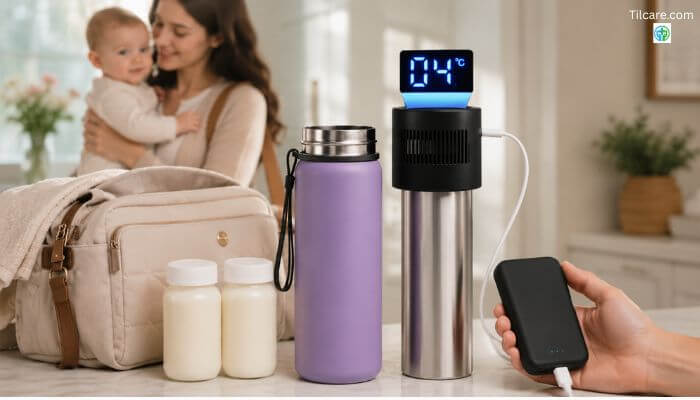
The best portable breast milk cooler is the one that keeps expressed milk cold for the full time you are away from a fridge. For most mums, that means an insulated cooler bag with fully frozen ice packs for short outings or workdays. For longer commutes, travel days, road trips, or repeated pumping sessions, a hard-case cooler or electric breast milk cooler may offer better protection and more consistent cooling.
According to CDC guidance, expressed breast milk can be stored in an insulated cooler with frozen ice packs for up to 24 hours while travelling. The right choice depends on four practical factors: how long you need cooling, how much milk you carry, whether you have access to power, and how easy the cooler is to clean after use.
For everyday pumping and daycare, a compact insulated cooler with frozen ice packs is usually enough. For long travel days, full work shifts, or repeated pumping, a hard-case cooler or electric breast milk cooler may be more practical.
Table of Contents
What is a portable breast milk cooler?
A portable breast milk cooler is a travel-friendly storage solution used to keep expressed milk cold when a refrigerator is not available. It is commonly used for work, daycare drop-offs, road trips, flights, errands, and full days away from home.
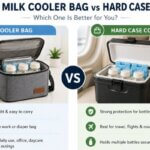
Unlike a regular lunch bag, a purpose-built breast milk cooler is usually designed around bottle fit, cold retention, leak control, and easy cleaning. The main options are insulated cooler bags with ice packs, hard-case coolers, thermos-style milk chillers, and electric breast milk coolers. None is automatically the best for every mum; the right choice depends on the length of the trip and the amount of milk being stored.
Also read: How to store breast milk while travelling?
Types
| Type | Best For | Cooling Method | Portability |
| Insulated bag with ice packs | Workdays, daycare, short travel | Frozen ice packs | High |
| Hard-case cooler | Road trips, flights, longer outings | Thick insulation + ice packs | Medium |
| Thermos-style chiller | Short outings or smaller milk amounts | Insulated bottle-style cooling | Very high |
| Electric breast milk cooler | Long commutes, travel, repeated pumping | Powered cooling | Medium |
What to look for before buying one?
- Insulation that holds temperature across real conditions: Manufacturer claims about cooling duration are measured under ideal circumstances. The question worth asking is how the cooler performs in a warm car, a busy airport, or a summer commute not in a controlled test. Thick insulation walls and a properly sealed closure determine real-world performance.
- Capacity: Two to four bottles or storage bags cover a single session or short outing. A full working day away from a fridge requires capacity for considerably more. Buying for the minimum requirement rather than the realistic demand is one of the most common cooler mistakes.
- Seal: Condensation and minor leaks reaching the bag interior create hygiene concerns that defeat the purpose of dedicated milk storage. A waterproof lining and a zip or clasp closure that seals properly rather than loosely prevent this.
- Fits where it needs to fit: A cooler that works in theory but does not fit inside a work bag, changing bag, or carry-on gets left behind or packed incorrectly. Check dimensions against the bags you actually use before purchasing.
- Interior that cleans properly: Smooth wipeable lining, detachable components, and no fabric interior that absorbs moisture make cleaning after use straightforward. Coolers with complex interior construction become hygiene risks over time if thorough cleaning is difficult.
- BPA-free throughout: Every surface in contact with milk containers, the interior lining, any included ice packs, and any fitted containers should be confirmed BPA-free. This is non-negotiable for anything used to store milk for an infant.
Comparison: Portable vs regular
| Feature | Breast Milk Cooler | Regular Lunch Cooler |
| Bottle compatibility | Shaped for standard bottle sizes | Generic sizing — bottles may not sit securely |
| Hygiene construction | Dedicated milk storage, wipeable interior | Multi-purpose, shared use design |
| Interior organisation | Separate sections for bottles, packs, accessories | Single undivided compartment |
| Temperature consistency | Engineered for sustained cold retention | Variable — quality dependent |
| Bag compatibility | Designed to fit work and changing bags | Bulkier, less considered dimensions |
| Purpose | Milk safety focused | General food and drink storage |
Pick the best portable breast milk cooler as per the requirements?
- Office and daily commuting: A medium insulated bag holding six to eight storage bags or bottles, with compartments that keep ice packs away from direct contact with milk containers, handles a standard working day. Slim enough to fit inside a work bag without taking over the entire space.
- Travel by air: A compact hard-case cooler or a high-quality insulated bag with multiple ice packs covers flight conditions. Frozen milk travels more safely on long-haul journeys than fresh, it extends the window significantly and acts as supplementary cooling for any fresh milk packed alongside it.
- Nursery and daycare runs: A small, clearly organised cooler bag that opens one-handed and fits easily into a changing bag covers the daycare scenario without adding complexity to an already busy morning.
- Road trips: An electric cooler connected to a car socket covers the duration of the drive without ice pack management. A backup insulated bag handles stops, hotel stays, and any period when the car is not running.
- High-volume pumping: For mums pumping multiple times daily, a larger capacity bag that holds a full day’s output without needing to be emptied or reorganised mid-day is the practical choice. Sustained insulation over eight or more hours matters more than compact sizing here.
Is an electric breast milk cooler worth it?
For a specific set of circumstances, yes. For general everyday use, not necessarily. The genuine advantage of an electric cooler is removing ice pack management from the equation on long commutes and extended working days, where refreezing packs between uses is not practical. Consistent temperature without the variable of ice pack quality and freeze level is the main selling point.
The practical limitation is power dependency. A cooler that requires a car socket or USB connection performs best when that power source is available. For longer commutes, travel days, or full work shifts, the Tilcare Electric Breast Milk Chiller can be a strong option because it is designed to help maintain cold storage for up to 24 hours when used as directed. For hotel stays, walking between locations, or any situation where the cooler is not near a power point, it functions as a basic insulated container. For mums whose routine includes consistent access to suitable power throughout the cooling window, the investment is justified. For everyone else, a high-quality insulated bag with reliable ice packs performs the same function at considerably lower cost.
Frequently asked questions
How long can breast milk stay cold in a cooler bag?
Up to 24 hours when stored in an insulated cooler with fully frozen ice packs, according to CDC guidance. Heat, frequent opening, and partially frozen ice packs can reduce that time
Can I bring a breast milk cooler on a plane?
Yes. TSA allows breast milk in carry-on bags in quantities greater than 3.4 oz / 100 ml. Separate it from other liquids and tell the officer before screening.
What is the best way to keep breast milk cold while travelling?
Use a purpose-built insulated cooler with fully frozen ice packs, keep it closed as much as possible, and store it in the coolest accessible place. For car travel, avoid leaving it in a hot boot. For flights, carry-on storage is usually more practical than checked luggage.
How many ice packs do I need for a breast milk cooler?
Two fully frozen packs for short outings, three to four for a full working day or longer journey where consistent cold is required throughout.
How to Store Breast Milk While Travelling? Guide (2026)