Breast Milk Cooler Bag vs Hard Case Cooler | Which Is Better?
If you are trying to decide between a breast milk cooler bag and a hard case cooler, the short answer is this a soft cooler bag handles everyday portability better, while a hard case earns its place on longer journeys where bottle protection and stable packing matter more.
Neither is universally better. The right choice depends entirely on where you are going, how long you will be away from a refrigerator, and how many bottles you are carrying.
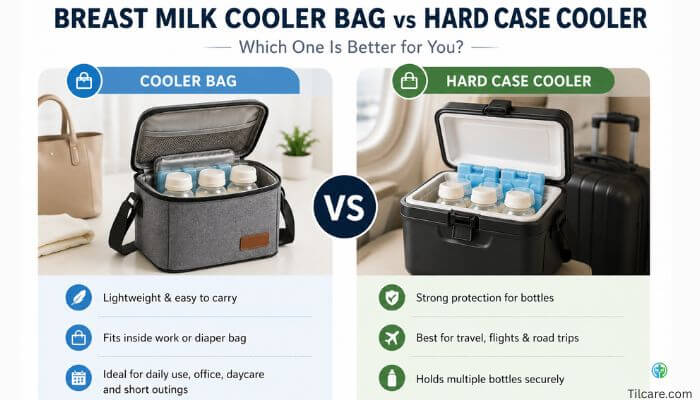
Choose a cooler bag for office pumping, daycare runs, short outings, and easy packing inside a work or changing bag. Choose a hard-case cooler for road trips, flights, full-day outings, and carrying several bottles with better protection and organisation.
Breast Milk Cooler Bag vs Hard Case Cooler? What is the main difference?
A cooler bag is built from flexible insulated fabric lightweight, compressible, and easy to slip inside a larger bag. It bends to fit available space rather than demanding its own. A hard case cooler has a rigid shell that holds its shape regardless of what is packed around it, offering structural protection that fabric cannot match.
The trade-off is straightforward. Fabric gives you portability and packability. Rigid construction gives you protection and organisation. Both keep milk cold but through a day of commuting, a flight, or a road trip, they behave very differently in practice.
When a cooler bag is the better choice?
A soft insulated cooler bag works well for the situations most pumping moms face on a regular basis:
- Office pumping where the cooler needs to fit inside a work bag without creating a second item to carry
- Daycare and nursery drop-offs where a compact, easy-access bag covers a short journey
- Short errands where a light, packable option is more practical than carrying a rigid case
- Moms who prefer a minimal setup and do not want to manage bulky equipment daily
When a hard case is the better choice?
A rigid cooler becomes the more practical choice when the journey is longer, the conditions are more demanding, or the bottle count is higher:
- Road trips where the cooler sits in a car for several hours and needs to maintain temperature without being repositioned
- Air travel where carry-on luggage gets compressed and shifted in overhead bins
- Full-day outings where a soft bag would be opened repeatedly, losing cold air each time
- Carrying four or more bottles were keeping them upright and organised genuinely matters
The trade-offs are real too. A hard case is heavier, takes up fixed space regardless of how much is inside it, and rarely fits neatly inside another bag. For a mum whose daily routine is a 20-minute commute and a standard working day, a hard case is more equipment than the situation requires.
Side-by-side comparison
| Feature | Cooler Bag | Hard Case Cooler |
|---|---|---|
| Weight | Light | Heavier |
| Portability | High — fits in other bags | Medium — carried separately |
| Bottle protection | Low — fabric offers no impact resistance | High — rigid shell protects contents |
| Cold retention | Good for short to medium outings | Better for longer or warmer conditions |
| Storage capacity | Flexible — adjusts to contents | Fixed — same size regardless |
| Organisation | Varies by design | Structured — bottles stay upright |
| Cleaning | Harder — fabric seams trap moisture | Easier — smooth wipeable interior |
| Durability | Moderate — seams wear over time | High — rigid shell holds up longer |
| Typical price | Lower | Higher |
| Best use case | Daily commute, office, daycare | Travel, road trips, longer days |
Which keeps breast milk cold more reliably?
The cooler format is only one part of the temperature equation. Insulation thickness, ice pack quality, ambient heat, how often the lid or zip is opened, and whether the cooler gets left in a warm car all affect how long milk stays within a safe temperature range.
A cooler’s shape alone does not determine how well it keeps milk cold. Insulation thickness, fully frozen ice packs, outside temperature, how tightly the cooler is packed, and how often it is opened all affect performance. According to CDC breast milk storage guidance, expressed milk can be transported in an insulated cooler with frozen ice packs for up to 24 hours.
That said, hard cases generally handle demanding conditions more consistently. A rigid shell with thick insulation walls loses temperature more slowly than a fabric bag when the outside temperature is high or the cooler is being opened regularly. A well-made soft cooler performs comparably on a normal workday in a cool environment the gap between the two formats widens as conditions become more challenging.
Neither format should be relied upon beyond its realistic performance window. Fully frozen ice packs, minimal opening, and keeping the cooler away from direct heat matter more than the format alone.
Everyday usability carrying, packing, and cleaning
A cooler bag wins on carrying comfort. It compresses to fit alongside everything else in a bag, weighs less, and does not add a separate item to manage. For a mom already carrying a laptop, pump, and changing bag, that difference is noticeable by midday.
A hard case wins on organisation. Bottles stay upright, ice packs sit where they are placed, and nothing shifts around during transit. The rigid interior is also significantly easier to wipe clean after a storage bag leaks fabric linings absorb moisture and odour in ways that smooth plastic interiors simply do not. For cleaning specifically, the hard case is the more hygienic long-term option. The soft bag requires more deliberate maintenance to stay genuinely clean rather than just surface-rinsed.
Best choice by situation
- Work and office pumping: A soft structured cooler bag — fits inside a work bag, light enough to carry all day, sufficient for a standard pumping schedule.
- Daycare: A compact cooler bag with clear bottle organisation — easy to hand over, easy for staff to access, no unnecessary bulk.
- Flights: A structured soft cooler or compact hard case depending on luggage space. For carry-on with multiple bottles, a hard case protects better in an overhead bin. For a single session, a soft cooler is sufficient.
- Road trips: A hard case more stable temperature over several hours, bottles stay upright, and the rigid structure handles being placed in a boot or back seat without compression risk.
- Short errands: A small insulated bag nothing more is needed.
- High-volume pumping: A larger hard case or structured bag with dedicated slots for six or more bottles and room for multiple ice packs alongside them.
For a full breakdown of cooler options across different budgets and use cases, refer to the guide on the best portable breast milk cooler.
When an electric breast milk chiller is worth considering?
Both formats above rely on ice packs which means they depend on packs being frozen before the journey and staying cold long enough to cover it. For moms managing long commutes, repeated pumping sessions throughout the day, or extended road travel, that ice pack dependency becomes a real logistical variable.
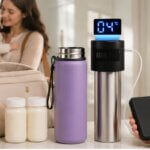
An electric breast milk chiller removes it. Active cooling maintains temperature consistently without requiring pre-frozen packs or monitoring how much cold is left. The Tilcare Electric Breast Milk Cooler is built for exactly these situations — long workdays, car commutes, and travel where consistent temperature matters more than compactness.
The limitation is power access. An electric chiller needs a USB, car socket, or wall connection to function as designed. For situations where that power source is reliably available throughout the cooling window, it outperforms both bag and hard case formats on temperature consistency. For situations involving movement between locations without consistent power — it functions as a basic insulated container.
For guidance on keeping milk safe across different travel situations, refer to the complete guide on how to store breast milk while travelling.
Conclusion
Choose a cooler bag when portability, light weight, and fitting into an existing bag matter most, daily commutes, office pumping, daycare, and short outings. Choose a hard case when bottle protection, stable organisztion, and sustained cold retention across longer or more demanding journeys are the priority, road trips, flights, and full-day outings. Consider an electric chiller when consistent active cooling and reliable power access align with the actual daily routine.
Frequently Asked Questions
Is a hard cooler better than a cooler bag for breast milk?
It depends on the situation hard cases offer better protection and temperature stability for travel, while cooler bags are more practical for daily commuting and office use.
Which type is better for air travel?
A compact hard case or structured soft cooler both work, hard cases offer better bottle protection in overhead bins while soft coolers compress more easily into carry-on luggage.
Can a regular hard cooler be used for breast milk?
Yes, but a purpose-built breast milk cooler fits bottles more securely, maintains hygiene more easily, and is designed around the specific temperature requirements of expressed milk.
Which type is easier to clean?
A hard case, the smooth rigid interior wipes clean quickly, while fabric cooler bag linings absorb moisture and require more deliberate cleaning to stay hygienic.
Which cooler is better for a full workday?
A structured cooler bag with sufficient capacity for the full day’s output and two to three fully frozen ice packs handles a standard workday reliably without requiring a hard case.
Best Portable Breast Milk Cooler | Buyer's Guide 2026