
How Long Should You Use a Breathing Trainer Daily? (2026 Guide)
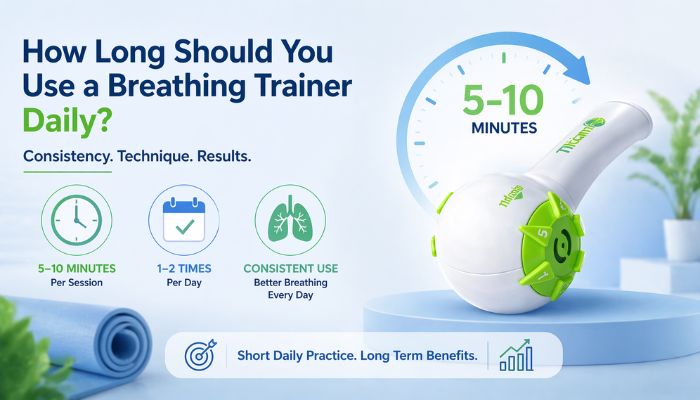
Most people either overdo it thinking more time means faster results, or underdo it and wonder why nothing is changing. The truth sits in the middle short, consistent sessions with controlled technique outperform long irregular ones every single time. Here is the realistic daily routine that actually works.
In short, you can do 5 to 10 minutes per session and 1 to 2 sessions per day. That is all you need. Do not overcomplicate it. A focused 5-minute session with proper technique delivers more value than 30 minutes of rushed, careless breathing.
Table of Contents
How Long Should You Use a Breathing Trainer Daily?
A simple structure that works for most users:
- At morning, 5 to 10 minutes as your primary session, ideally before physical activity or exercise
- At evening, optional repeat of 5 minutes, particularly useful if you are training for performance
- Breathe slowly and in a controlled manner throughout, never rush the inhale or exhale
- Rest for 2 to 3 seconds between breaths to avoid light-headedness
- Keep resistance at a level where you can maintain clean technique for the full session
Is it better to do more?
No, more time does not mean better results with a breathing trainer. Pushing beyond 10 to 15 minutes per session leads to:
- Fatigue — the respiratory muscles tire out and technique breaks down
- Poor breathing pattern — fatigued muscles produce rushed, shallow breaths that reinforce bad habits rather than good ones
- Diminishing returns — beyond a certain point, additional minutes add no benefit and increase the risk of dizziness or discomfort
How often per week?
Daily use is ideal. If daily is not always possible, a minimum of 5 days per week maintains consistent progress. Dropping below that slows results noticeably. Unlike heavy gym training, a breathing trainer does not require rest days the sessions are short enough that daily use is safe and sustainable for most healthy users.
When will you see results?
Stay realistic about the timeline:
- 1 to 2 weeks — you develop awareness of your breathing pattern and begin engaging the diaphragm more consciously
- 3 to 4 weeks — noticeable improvement in breathing control during daily activity and light exercise
- 4 to 8 weeks — measurable endurance improvement during sustained physical effort
Results depend on consistency, starting fitness level, and technique quality. For a deeper look at what actually improves, refer to the lung capacity guide.
Signs you are doing it right
You are on track when:
- Breathing feels smoother and less effortful during sessions over time
- You need less conscious effort to engage the diaphragm
- Breathing control during physical activity noticeably improves
- Sessions feel easier at the same resistance level, a sign it is time to increase gradually
Signs you are overdoing it
Stop or reduce intensity if you experience:
- Dizziness or light-headedness during or after a session
- Unusual fatigue in the chest or breathing muscles
- Irregular or laboured breathing that does not settle quickly after finishing
- Headaches following sessions
These are signals that sessions are too long, resistance is too high, or rest between breaths is insufficient. Scale back and rebuild gradually.
Common mistakes that most people do?
The most frequent errors that slow progress:
- Rushing breaths — fast shallow breathing defeats the purpose of resistance training entirely
- Starting with too much resistance — high resistance too early builds frustration, not strength
- Inconsistent routine — three sessions one week and none the next produces no meaningful progress
- Skipping the rest between breaths — recovery between each breath is part of the technique, not optional
Quick tip for beginners
Start at the lowest resistance setting and focus entirely on technique before increasing difficulty. Slow, deliberate breathing with full diaphragm engagement at low resistance is more effective than fast breathing at high resistance. Once sessions feel comfortable and controlled for a full week, step up the resistance gradually. For a complete beginner routine, refer to the breathing exercises guide.
If you are starting a daily routine, a breathing trainer for home practice can help add structure and adjustable resistance to short inhale and exhale sessions. Start with light resistance, keep sessions comfortable, and build gradually as your breathing control improves.
Frequently Asked Questions
Can you use it multiple times a day?
Yes, two sessions of 5 to 10 minutes are fine. Beyond that, the benefit decreases and fatigue becomes a factor.
Is daily use safe?
Yes, for healthy users. Sessions are short enough that daily practice is safe and recommended for consistent progress.
Can you skip days?
Occasionally skipping is fine. Making it a habit significantly slows results — aim for a minimum of 5 days per week.
When should you stop?
Stop immediately if you feel dizziness, chest discomfort, or laboured breathing that does not settle quickly. If symptoms persist, consult a doctor before continuing.

Can a Breathing Trainer Improve Lung Capacity? (2026 Guide)



)
)