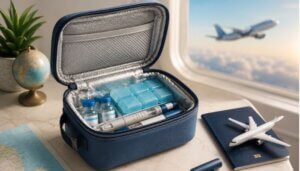
Insulated Bag vs Cooler: Which One Is Right for You?

A lot of travel cooling options look interchangeable at first glance, but an insulated bag and a cooler aren’t really built for the same job. An insulated bag can seem like the simpler, grab-and-go option, while a dedicated cooler often comes with features aimed at longer trips and more structured storage. Which one actually makes sense depends on a few things: how long you’re travelling, how you’re getting there, how much you need to carry, and how much convenience you’re after.
Quick Answer
The better choice between an insulated bag and a cooler for insulin travel depends on your trip length, storage needs, and travel conditions. Insulated bags are lightweight and practical for short daily trips, while coolers offer more structure and are better suited for longer journeys where additional cooling support may be needed.
For frequent travellers, a dedicated insulin cooler case can provide better organization and convenience compared with adapting a general-purpose bag. Keep reading to see how each option compares across different travel situations and which one fits your needs best.
Table of Contents
What is an insulated bag?
An insulated bag is exactly what it sounds like, a soft-sided bag with insulated walls or lining that helps slow down temperature change inside. It doesn’t actively cool anything, it just buys time by limiting how fast outside heat gets in. That makes it a common pick for everyday carrying, since it’s lightweight, flexible, and doesn’t take up much room in a larger bag or backpack.
The tradeoff is that most insulated bags are general-purpose by design. They’re not built with insulin specifically in mind, so organization tends to be basic, usually one main compartment rather than dedicated sections for different supplies.
What is a cooler?
Coolers are a step up in structure. Instead of just slowing temperature change, they’re built to actively maintain a cooler environment for longer stretches, either through cooling elements packed alongside your supplies or, in the case of electric models, a powered cooling system that runs on its own.
Passive coolers rely on ice packs or gel elements and need some prep beforehand. Electric coolers handle the cooling themselves but require charging and tend to be bulkier as a result. Neither is inherently “better,” they’re just suited to different kinds of trips.
Insulated bag vs. Cooler: Comparison
| Feature | Insulated Bag | Cooler |
| Design | Soft and flexible | More structured |
| Portability | Lightweight, easy to carry | Usually bulkier |
| Storage organization | Basic compartments | More dedicated storage options |
| Trip length | Better for shorter trips | Better for longer journeys |
| Space required | Minimal | Requires more room |
| Cooling approach | Passive insulation | Passive or powered options |
| Best use | Daily carrying | Extended travel |
Which option works better for different travel situations?
- Short daily trips: For a work commute, a quick errand, or a local outing, a lightweight insulated bag usually covers what’s needed without adding extra bulk. There’s no real advantage to hauling a full cooler for a trip that’s over in an hour or two.
- Air travel: Carry-on space is limited, so something compact that’s still easy to access during the flight tends to work best. Whether that’s an insulated bag or a smaller cooler often comes down to trip length and how much you’re carrying. Our guide on how to travel with insulin on a plane goes further into the logistics of that.
- Road trips: Longer stretches without access to refrigeration change the equation. A cooler, especially one with active cooling, tends to hold up better over a full day of driving than a bag relying on insulation alone. Organization also matters more here, since you’ll likely be reaching for supplies at multiple stops. For more detail, see how to pack insulin for a road trip.
- Outdoor trips: Weather exposure and longer stretches away from any refrigeration make preparation more important outdoors than almost anywhere else. A cooler generally offers more buffer here than a bag alone, particularly in warmer conditions.
Features
Rather than treating this as strictly bag versus cooler, a few specific features tend to matter more in practice.
- Size and capacity should match what you’re actually carrying. Bringing just a pen and a couple of supplies doesn’t call for the same setup as a multi-day trip’s worth of medication.
- Organization makes a bigger difference than people expect. Separate compartments mean less digging around when you need something quickly.
- Durability matters for anything getting regular travel use, zippers and seams that hold up to repeated opening and closing, and materials that don’t wear down after a few trips.
- Portability depends on how you travel. Something that fits easily into a backpack or personal item works differently than something meant to sit in a car for a week.
Insulated bag vs. Dedicated insulin cooler case
| Feature | General Insulated Bag | Insulin Cooler Travel Case |
| Designed specifically for insulin supplies | No | Yes |
| Organization | General storage | Dedicated layout |
| Travel focus | General carrying | Medication travel |
| Convenience | Depends on design | Built around specific needs |
A general insulated bag can get the job done for some situations, but it wasn’t designed around the specific needs of carrying insulin, dedicated cases are. For a full breakdown of what to look for in one, our buyer’s guide to insulin cooler travel cases covers that in detail.
Where a dedicated insulin cooler case fits?
For travellers who’d rather not adapt a general-purpose bag to the job, a dedicated setup offers a more organized alternative. Tilcare offers two versions depending on how hands-on you want the cooling process to be. The Insulin Cooler Travel Case is a passive, insulated option built around portable, organized storage for shorter trips or daily use. The Electric Insulin Cooler Travel Case adds a powered cooling system for travellers who want more consistent temperature control on longer trips without relying on ice packs or cooling elements.
For the complete picture on preparing insulin for any kind of trip, our pillar guide on how to keep insulin cool while travelling covers the full process. The FDA’s medication travel guidance is also a useful reference for general best practices when travelling with temperature-sensitive medication.
Frequently asked questions
Is an insulated bag the same as a cooler?
Not quite. An insulated bag slows temperature change passively, while a cooler is built to actively maintain a cooler environment, sometimes with powered cooling.
Which is better for insulin travel: an insulated bag or cooler?
It depends on the trip. Bags work well for short, everyday carrying, while coolers tend to hold up better on longer trips or in warmer conditions.
Can I use a regular insulated lunch bag for insulin?
It can work for short trips, though it won’t offer the same organization or extended cooling that a dedicated case provides.
Is a cooler better for long trips?
Generally yes, especially trips that involve extended time away from refrigeration.
What should I look for in an insulin travel cooler?
Size that matches what you’re carrying, solid organization, durability for repeated use, and a cooling approach suited to your trip length.
Best Insulin Cooler Travel Case? Buyer's Guide 2026