
How to Store Breast Milk While Travelling? Guide (2026)
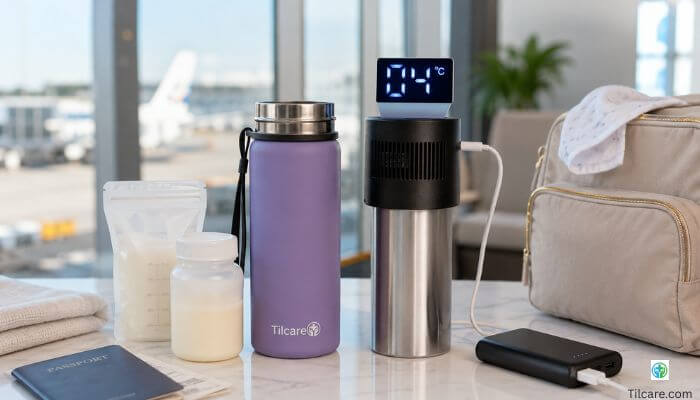
Travelling while pumping or breastfeeding takes more planning than most parents expect. Knowing how to store breast milk on the go can make the difference between a calm trip and constant second-guessing. At home, everything is familiar: the fridge is close, the freezer is reliable, and you know exactly where your bottles, bags, and ice packs are kept. Once you are in a car, airport, hotel room, or outdoor setting, that routine changes quickly.
It’s far more manageable than that first wave of panic suggests. This guide walks through how long expressed milk keeps, what to carry it in, how to pack it so it survives the trip, and the moment you should stop trusting a bottle and tip it out.
Table of Contents
how to store breast milk on the go?
The simplest way to store breast milk on the go is to pack it in labelled breast milk storage bags or secure containers, place them inside an insulated cooler, and keep the cooler cold with fully frozen ice packs. The milk should stay protected from heat, direct sunlight, and long periods at room temperature. Whether you are travelling by car, flying, staying in a hotel, or spending the day outside, the goal is to keep the milk cold and easy to identify until it can be refrigerated, frozen, or used.
How long does breast milk last without a fridge?
Knowing the safe windows is where everything else starts. Health bodies broadly agree on these figures for freshly expressed milk:
- Left out at room temperature (roughly 25°C or below): around four hours
- Packed in an insulated cooler with ice packs: up to a full 24 hours, as long as it stays properly cold
- In the fridge: up to four days from the moment you pumped
- In the freezer: about six months in a standard freezer, and longer in a deep freezer
- Think of those as ceilings rather than targets. The colder the milk stays and the sooner it’s used, the better.
Best containers for milk on the move
For travel, the pre-sterilized bags made for the job are hard to beat. They pack flat, weigh next to nothing, slot into any cooler or fridge, and come with a panel for noting the date and amount †no extra tubs required. If you’re nervous about a bag splitting, say on a bumpy coach or crammed into a packed case, rigid BPA-free pots with a proper screw lid are far harder to puncture or leak. The trade-off is bulk; they eat more space than bags do.
Setting off with milk you’ve already frozen actually makes the temperature problem easier. A frozen bag doubles as a cool pack, keeping everything around it cold while it slowly defrosts, and it buys you far more time than fresh milk on a longer trip where you can’t count on a fridge turning up.
Packing milk perfectly during the trip
The container only does half the work; how you pack it matters just as much. A perfectly good bag that bursts in your luggage because it was thrown in loosely is still a ruined journey:
- Write on everything before you leave: date, time, and volume on every bag. It’s a thirty-second job that saves you squinting at unmarked bags later, trying to work out which pumping session was which.
- Bag each one twice. Slide every storage bag into a second sealable bag before it goes in the cooler. If one gives way, the spare keeps the spill contained.
- Freeze the ice packs all the way through. A block that’s only half-frozen warms up far quicker than a solid one, so give them a full night in the freezer rather than a quick couple of hours.
- Fill the gaps. A cooler holds its temperature better when it’s packed tight, so if you’re short on bags, plug the space with extra ice packs instead of leaving it half-empty.
- Keep it separate where you can. A standalone cooler bag, rather than a pocket inside a larger bag, lets you manage the cold on its own terms. If you want the full step-by-step, there’s a separate guide on how to pack breast milk for travel.
Keeping milk cold in every travel situation
In the car, a boot sitting in summer sun can climb high enough to spoil milk within an hour, so the cooler rides up front where the air conditioning reaches it †never in the back. Don’t leave it in a parked car in the heat either, even briefly. It isn’t worth the gamble.
- At the airport, breast milk counts as a medically necessary liquid in most countries, which means it skips the usual liquid limits at security. Give staff a heads-up before you go through the scanner. Milk that has partly thawed is still allowed in most places.
- At a hotel, mini-fridges are a lottery †some are genuinely cold, others barely take the edge off the room. Pop a thermometer in if you have one, or ask reception for a full-size fridge; most can sort that out.
- Camping or out and about, a solid insulated cooler with enough frozen packs will hold up for a day or so. The trick is starting with milk that’s already chilled or frozen, rather than warm from the pump. For more on this, see the guide on how to keep breast milk cold without a fridge.
Mistakes to avoid
Treating a lunch bag like a cooler is the classic one. Your everyday insulated lunch bag isn’t built for this †the walls are thinner, the seal is looser, and there’s nowhere near the room for ice packs. Across a long day, it simply can’t hold the cold the way a purpose-made cooler does. Refreezing milk that has fully defrosted is another. Once milk has thawed all the way through, it doesn’t go back in the freezer. If there are still ice crystals in it, refreezing is generally considered fine, but fully liquid milk should be used within the normal fridge window instead.
Underestimating the journey trips a lot of people up, too. Always pad your timing. A three-hour trip has a habit of becoming five, and packing for the schedule rather than the worst case is the single most common reason milk ends up out of time on arrival. Trusting a shared fridge is a risk you don’t need to take. Communal fridges in airport lounges, offices, or any shared space carry contamination and temperature problems that your own cooler doesn’t. Keep your milk in your own bag.
Skipping the airline’s rules is the last avoidable one. Policies shift between airlines and between countries, and finding out about a restriction at the gate with no backup plan is exactly the kind of stress a two-minute check beforehand removes.
Choosing a chiller bottle that actually works
The cooler is the one piece of kit worth getting right. A few things make the real difference once you’re actually on the road. Start with how long it holds the cold. Forget the lab numbers †what counts is how it performs on a long, real-world journey. Thick insulated walls and a snug-fitting lid beat thin, floppy bags that surrender their cold within the hour.
For travel days when fridge access is limited, a portable breast milk chiller can help keep pumped milk cold in a dedicated bottle instead of relying only on loose ice packs or a shared cooler bag.
Look at how it works with its ice packs. Coolers built around packs that fit the interior neatly stay colder than ones where you’re cramming loose blocks in around the bags. Match the capacity to your day. Count your likely pumping sessions and pack to suit. Something that takes four to six bags comfortably covers most day trips; longer hauls call for a bigger cooler or somewhere to refreeze along the way. Be honest about whether you’ll carry it. A cooler that tucks into hand luggage and sits easily on a shoulder is one you’ll actually use. An awkward, heavy one gets left behind or packed wrong.
Finally, check how easy it is to clean. Condensation and small spills leave residue and odours behind, so a smooth lining and removable parts make the regular clean far less of a chore. There’s a full bag-versus-hard-case comparison in the guide on breast milk cooler bag vs hard case cooler.
When to pour the milk away?
Knowing when to bin a bottle matters as much as knowing how to keep it. Tip it out when:
- It has sat at room temperature for more than four hours
- The ice packs have melted through, and the cooler is no longer cold inside
- Previously frozen milk has fully thawed and then sat in the fridge past the usual window
- It smells sour or soapy, different from its usual scent
- You simply aren’t sure the storage held up; if it’s a guess rather than a certainty, don’t risk it
Frequently asked questions
How long can breast milk stay in an insulated cooler while travelling?
Up to 24 hours, as long as the cooler stays consistently cold with fully frozen ice packs.
Can you bring breast milk through airport security?
Yes, it’s classed as a medically necessary liquid in most countries and isn’t subject to standard liquid limits, so just flag it to security before screening.
Is it safe to refreeze breast milk that has partially thawed?
If ice crystals are still present, it’s generally safe to refreeze, but fully thawed milk should be used within the normal fridge window instead.
What is the safest way to transport breast milk on a long road trip?
Keep the cooler up front in the air-conditioned cabin rather than the boot, start with cold or frozen milk, and use ice packs fully in a tightly packed cooler.
How do you know if breast milk has gone off during travel?
A sour or unusually soapy smell is the clearest sign, and if you can’t be sure about the time and temperature it’s been through, pour it away rather than risk it.

How to Practice Singing Quietly at Home? (Complete Guide 2026


)
)