How Often Should You Clean Your Ears? 2026 Guide
Most people don’t need to clean their ears regularly, but some do. The right frequency depends on how much ear wax your body produces, your habits (like using earbuds), and whether you’re experiencing symptoms like blockage or muffled hearing. It’s also important to understand that your ears have natural self-cleaning properties., and the same goes for the ear. Although ears are self-cleaning, not always so; it is important to take care of your ears also.
However, if you are unsure when and how to remove ear wax safely at home, you can also follow this stepwise guide.
Table of Contents
Do you actually need to clean your ears?
As we know, our body has natural healing properties, but sometimes due to the living style, it requires an extra push to maintain the body’s mechanisms. Similarly ear also has self-cleaning properties. While we chew or talk, our jawlines shake, and due to continuous movement, the earwax rolls out near the ear exit. You must also know that the ear wax formation is due to the dust particles, debris and water they mixed-up and form a wax-type glue. However, this wax also protects the ear canal from any foreign particles.
Now the question is, do we need to clean our ears regularly? So, yes, but only when the wax is built up, or if one is facing issues like muffled or low hearing, ringing ear, and discomfort in the ear. There are multiple solutions available for it, like ear drops and ear wax removal tools, which can be used for self-cleaning at home.
Signs that cleaning may be needed:
- Muffled or reduced hearing that hasn’t cleared on its own
- A persistent feeling of fullness or pressure in the ear
- Ringing or buzzing sounds (tinnitus)
- Noticeable discomfort or itchiness inside the canal
- Wax is visibly present at the outer entrance of the ear
What are the safest ways to clean your ears at home?
If you’ve identified that there is a genuine build-up, there are a few safe, practical methods to address it.
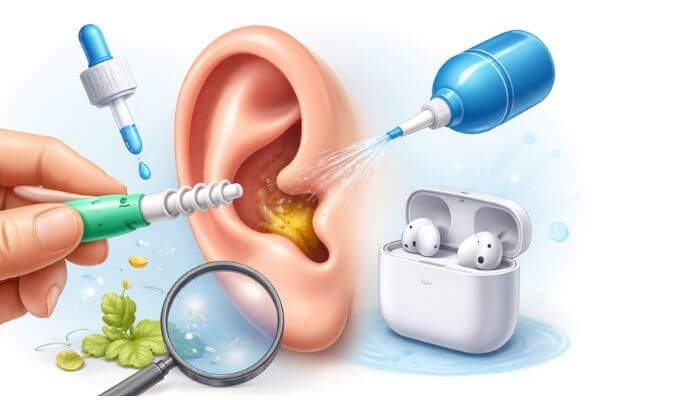
1. Ear drops: This is the most widely recommended starting point for home ear cleaning. A few drops of an appropriate solution, such as olive oil, hydrogen peroxide, or carbamide peroxide, are placed into the ear while tilting the head sideways at roughly 90 degrees. Hold the position for a minute or so to allow the liquid to travel through the canal and reach the wax. The solution gradually softens and loosens the wax so it can either drain out naturally or be cleared more easily with a follow-up rinse. Most drops may need to be used for a few days before the wax fully shifts.
2. Ear irrigation: Once the wax has been softened with drops, warm water can be gently directed into the ear canal using a bulb syringe to flush it out. The water pressure dislodges the loosened wax and carries it toward the exit. Always use water close to body temperature. Water that’s too cold or too hot can trigger dizziness. The NHS recommends softening ear wax with drops for a few days before attempting irrigation, as this makes the process more effective and comfortable.
3. Ear wax removal tools: Both manual and electric options are widely available for home use check this guide on ear drops vs ear wax removal tool. Manual tools such as soft silicone curettes or scoop-shaped picks can gently collect wax that has moved close to the outer entrance of the canal. Electric devices use suction or soft rotation to draw wax outward.
These tools work best after softening. Using them on dry, compacted wax can be uncomfortable and less effective. Camera-assisted tools are also available and offer the advantage of letting you see exactly what you’re doing, reducing the risk of pushing wax further in. In many cases, combining drops with one of the physical methods or ear wax removal tools gives the best outcome, especially when wax has been building up for a while. For occasional visible wax buildup, an ear cleaning tool for routine care can help you clean more carefully than using cotton swabs, especially when used gently and only on the outer ear canal area.
What should you never do?
There are a few habits that are surprisingly common but genuinely counterproductive and, in some cases, harmful.
- Cotton buds: They’re cheap, widely available, and feel like they should work. The problem is they don’t — not in the way most people think. Rather than pulling wax out, cotton buds tend to push it further into the canal, compacting it against the eardrum. You might clean up a small amount of surface wax at the very entrance, but the wax sitting deeper gets pushed inward. Over time, this is one of the most common causes of wax impaction. Both the NHS and Mayo Clinic advise against using cotton buds inside the ear canal for this reason.
- Sharp or makeshift objects: Hairpins, pen lids, folded paper, anything sharp or rigid has no place inside the ear canal. The skin lining the canal is delicate, and even light scratching can cause cuts, irritation, or infection. In more serious cases, pushing objects too far can damage the eardrum, which may result in lasting problems. If the wax feels deep and unreachable, that’s a sign to use drops or seek professional help, not to improvise.
- Over-cleaning: This one often goes unnoticed as a problem because people assume cleaner is always better. It isn’t. Removing wax too frequently strips the canal of its natural moisture and protective coating. This can lead to dry, itchy skin inside the ear, increased irritation, and ironically, a higher chance of infection, since the wax that normally keeps bacteria and debris out is no longer there. If your ears feel fine, leave them alone.
When to see a doctor?
Home cleaning has clear limits, and knowing when to step back is just as important as knowing how to clean safely.
Seek professional advice if you experience any of the following:
- Pain that is increasing or doesn’t settle after a day or two
- Discharge from the ear, particularly if it has an odour or unusual colour
- Sudden hearing loss in one or both ears
- No improvement after using the ear drops consistently for a week
- Dizziness or balance issues alongside hearing changes
- A history of perforated eardrums, ear surgery, or grommets
Frequently Asked Questions
Can you clean your ears daily?
No, daily cleaning disrupts the ear’s natural process and can strip away the protective wax your ear actually needs.
Is it bad to never clean your ears?
For most people, it’s completely fine. The ears are self-cleaning, and if there are no symptoms of build-up, no intervention is needed.
Do earbuds increase ear wax build-up?
Yes, they can. Regular use of in-ear earbuds may interfere with the natural outward movement of wax and push it deeper into the canal over time.
Should children’s ears be cleaned?
Only if there are signs of build-up or discomfort. Children’s ears are also self-cleaning, and routine cleaning is generally unnecessary unless a problem is present.
How often should someone prone to wax build-up clean their ears?
There’s no fixed rule, but if you regularly experience build-up, using softening drops every few weeks as a preventive measure rather than waiting for symptoms can help keep things manageable.
Can ear cleaning cause an infection?
It can, if done incorrectly. Inserting objects, using unclean tools, or cleaning too aggressively can irritate the ear canal and create conditions where infection is more likely. Sticking to drops and gentle rinsing significantly reduces this risk.
Can Ear Wax Cause Hearing Loss? 2026 Guide