
5 Breathing Exercises with a Lung Trainer (Step-by-Step Guide)
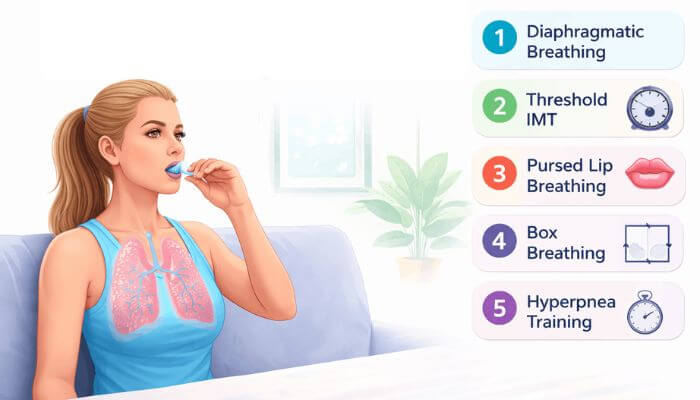
If you’ve recently started using a breathing trainer, you might be wondering: What’s the best way of lung trainer exercises? You’re not alone. Many people buy respiratory training devices with the best intentions, only to let them collect dust because they’re unsure where to start. The good news? Getting started is simpler than you think.
A breathing trainer isn’t just about blowing into a device randomly—it’s about practicing specific techniques that strengthen your respiratory muscles, improve lung capacity, and help you breathe more efficiently throughout your day. In our previous guide on “what breathing trainers are and how they work,” we covered the science behind these devices.
Today, we’re diving into the practical side: five foundational breathing exercises you can start practicing right away, whether you’re an athlete looking to boost performance, someone managing a respiratory condition, or simply wanting to breathe better.
Table of Contents
Before you begin: A quick setup guide
If this is your first time using a breathing trainer, start with the lowest resistance setting. Think of it like going to the gym—you wouldn’t start with the heaviest weights on day one. Your respiratory muscles need time to adapt.
Here’s what to keep in mind that practice in a comfortable, seated position with good posture:
- Start with 5-10 minutes per session
- 1-2 times daily – Breathe through your mouth when using the device (not your nose)
- If you feel dizzy or lightheaded, take a break—this is normal at first
- Stay consistent—results typically show within 2-4 weeks of regular practice Now, let’s explore the exercises.
5 best breathing exercises with a lung trainer/breathing trainer
Below are five exercises commonly used in respiratory muscle training routines. They can be adjusted based on your comfort level and training goals:
Exercise 1: Diaphragmatic breathing with resistance
Before you even touch an advanced lung trainer setting, you need to master diaphragmatic breathing — also called belly breathing or abdominal breathing. This technique ensures that you’re using the largest, most powerful breathing muscle in your body rather than relying on shallow chest breathing, which is the default for most sedentary adults.
Diaphragmatic breathing alone has been shown to reduce cortisol levels, lower resting heart rate, and improve oxygen saturation. When combined with even low-level IMT resistance, the benefits multiply significantly.
How to perform it?
- Sit upright in a comfortable chair, or lie on your back with knees slightly bent.
- Place one hand on your chest and the other on your belly button.
- Set your lung trainer to its lowest resistance level.
- Inhale slowly through the device for 4 counts — your belly should rise, but your chest should stay relatively still.
- Remove the device and exhale gently through pursed lips for 6–8 counts, allowing your belly to fall.
- Repeat for 10 breaths, rest 30 seconds, then complete 2–3 more sets.
Pro Tip: If you notice your chest rising more than your belly, place a small book on your abdomen. The goal is to lift the book with each inhale. This simple biofeedback cue accelerates learning dramatically.
What the research says?
A systematic review in the European Respiratory Journal analyzed 12 randomized controlled trials and confirmed that diaphragmatic breathing training significantly reduces dyspnea (shortness of breath) in patients with COPD and improves diaphragmatic strength across healthy populations. Even eight weeks of practice showed measurable improvements in spirometry readings.
Exercise 2: Threshold Inspiratory Muscle Training (Threshold IMT)
Threshold IMT is arguably the most scientifically validated form of lung training available today. Unlike simple breathing devices that use a fixed narrow opening, threshold trainers use a spring-loaded valve that maintains a consistent resistance level throughout the entire inhale — regardless of how fast or slow you breathe. This makes the workout far more precise and progressive.
This technique is used by professional athletes, military personnel, cardiac rehabilitation patients, and people with chronic lung disease. The principle is simple: breathe against resistance, get stronger.
How to perform it?
- Set your threshold IMT device to approximately 30% of your maximum inspiratory pressure (MIP). Most devices such as Tilcare lung trainer come with a calibration guide; if you’re new to this, start conservatively.
- Sit upright with good posture. Hold the device with both hands and create a tight seal with your lips around the mouthpiece.
- Inhale forcefully and deeply through the device — you’ll feel the resistance of the spring valve. The inhale should take about 2–3 seconds.
- Remove the mouthpiece and exhale normally without restriction for 3–4 seconds.
- Complete 30 breaths per session. Rest 1 minute if needed between sets of 10.
- Perform once daily, 5–7 days per week. Increase resistance by 5% every 2 weeks as tolerated.
The standard clinical protocol for threshold IMT, as used in most research trials, involves 30 breaths per day at 50% of maximum inspiratory pressure. However, for beginners, starting at 30% and building gradually is both safer and more sustainable.
Safety Note: If you feel dizzy, experience chest tightness, or develop headaches during training, stop immediately and reduce the resistance. These symptoms often indicate overexertion or breath-holding. Always breathe continuously — never hold your breath during IMT.
Performance and clinical benefits
Research published in Medicine & Science in Sports & Exercise demonstrated that eight weeks of threshold IMT at 50% MIP improved cycling time-trial performance by an average of 4.6% in recreational cyclists — a meaningful gain equivalent to months of additional endurance training. In a separate clinical trial involving heart failure patients, daily threshold IMT reduced hospitalizations and improved quality-of-life scores over six months.
Exercise 3: Pursed Lip Breathing with Expiratory Resistance
Pursed lip breathing is one of the oldest and most clinically recommended breathing techniques for people with respiratory conditions — but it works just as well for healthy individuals looking to improve respiratory efficiency. When you add gentle expiratory resistance using a lung trainer, you amplify its benefits considerably.
The mechanics behind pursed lip breathing are elegant. By slowing the exhale, you maintain slightly elevated pressure in the airways during expiration. This prevents the small airways from collapsing prematurely — a problem that’s central to conditions like COPD and asthma, but that also affects people with naturally narrow airways or those who have spent years breathing shallowly.
How to perform it?
- Sit in a comfortable, upright position with your shoulders relaxed — not hunched forward.
- Breathe in slowly through your nose (without the device) for a count of 2.
- Attach your expiratory lung trainer with light resistance, or simply purse your lips tightly as if you’re about to whistle.
- Exhale through the device (or pursed lips) for a count of 4 — exactly twice as long as the inhale.
- Keep the exhale slow, controlled, and completely steady. Avoid puffing or blowing hard.
- Repeat for 15–20 breaths. Practice 2–3 sessions per day, especially during and after physical activity.
Exercise 4: Box Breathing with Inspiratory Load
Box breathing — also known as square breathing or 4-4-4-4 breathing — is a structured technique used by Navy SEALs, elite athletes, surgeons, and trauma therapists. It involves equal counts for inhaling, holding, exhaling, and holding again, creating a rhythmic “box” pattern. When performed through a lung trainer on the inhale phase, it becomes a potent combination of mental regulation and respiratory muscle training.
The hold phases are particularly valuable. Breath-holding after inhale trains the chemoreceptors in your brain to tolerate slightly higher carbon dioxide levels — a skill that, counterintuitively, improves your ability to feel calm and in control rather than panicked when breathing becomes difficult during exertion.
How to perform it?
- Sit in a relaxed but upright position. Set your lung trainer to a moderate resistance level (about 30–40% of your maximum).
- Inhale through the lung trainer for 4 counts — draw the breath deep into your belly and lower lungs.
- Remove the mouthpiece. Hold your breath gently (not with gritted tension) for 4 counts.
- Exhale naturally and slowly through pursed lips for 4 counts.
- Hold at the bottom of the exhale (lungs empty) for 4 counts.
- That is one complete box. Perform 6–8 boxes per set, 1–2 sets per session.
- As you become more comfortable, extend the count to 5-5-5-5 or 6-6-6-6.
Exercise 5: Hyperpnea Training (Normocapnic Hyperpnea)
Hyperpnea training — sometimes called normocapnic hyperpnea or voluntary isocapnic hyperpnea — is the most intense form of respiratory muscle training. Unlike the other techniques in this guide, which use resistance to slow or challenge the breath, hyperpnea training involves breathing rapidly and deeply at high volumes for extended periods using a specialized device that recirculates your exhaled CO2. This prevents the drop in carbon dioxide levels that would otherwise cause dizziness or fainting during fast breathing.
Purpose-built hyperpnea trainers (such as the SpiroTiger) are designed specifically for this protocol. They include a breathing bag and mouthpiece that maintain normal blood CO2 while you breathe at 60–80% of your maximum ventilation. The result is an intense workout for the respiratory musculature that closely mimics the demands of sustained high-intensity exercise.
How to Perform It?
- Assemble your hyperpnea trainer according to the manufacturer’s guide. These devices are not interchangeable with standard IMT devices — make sure you’re using equipment designed for this protocol.
- Begin breathing in and out of the device at a rate that feels challenging but sustainable — typically 30–40 breaths per minute.
- Maintain this elevated breathing rate for a continuous 20–30 minute session.
- Your breathing muscles — specifically the diaphragm, external intercostals, and scalene muscles — will fatigue noticeably. This is the intended training stimulus.
- Perform 3–5 sessions per week. Most users see significant adaptation within 4–6 weeks.

What Is a Breathing Trainer? Benefits and How It Works




)
)